Application·
Zoho Desk: bringing order to customer support in UAE businesses
Zoho Desk for UAE businesses: how a proper ticketing system replaces support-over-WhatsApp, with SLAs, knowledge bases and multi-channel inboxes explained plainly.

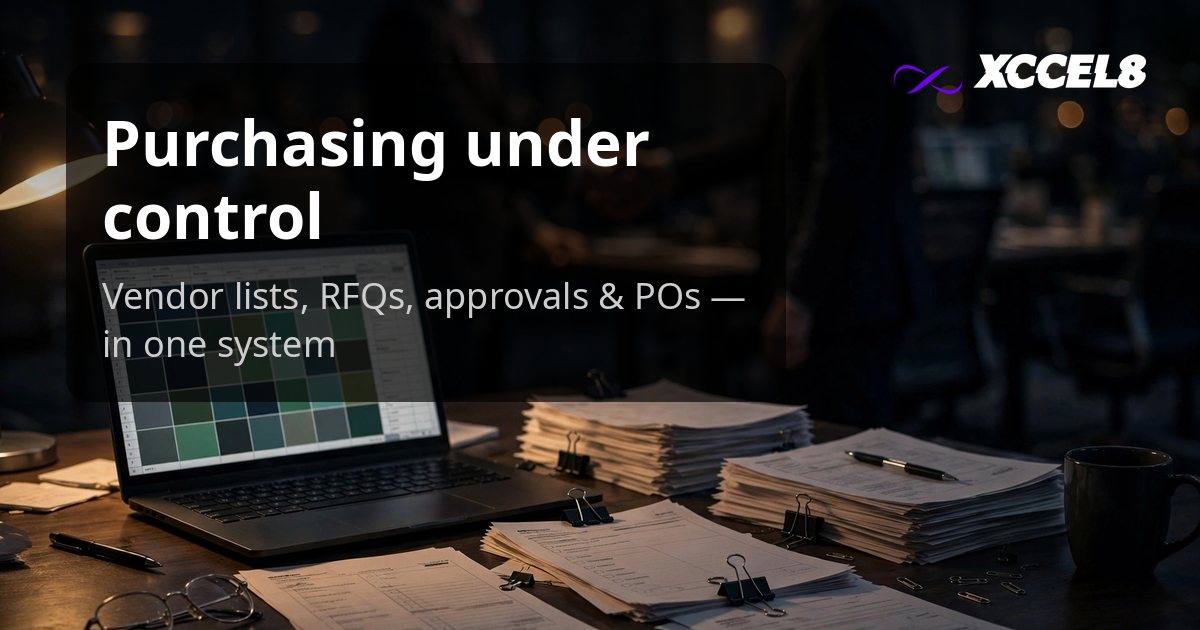
Most growing businesses buy the way they started buying: someone needs something, they ask around for a supplier, they get a quote on WhatsApp, the manager approves it in a reply, and the invoice arrives a month later with nobody quite sure what was agreed. It works at ten people. At thirty, it leaks money — duplicate vendors, uncompared prices, approvals nobody can trace, and purchase orders that exist only as email threads. Zoho Procurement replaces that improvisation with a proper purchasing system: one place where vendors are managed, prices are compared, requests are approved, and orders are tracked.
The core idea is simple. Every purchase follows the same controlled path: a purchase request is raised, it goes through the right approvals, quotes are gathered and compared, a purchase order goes to the chosen vendor, and the goods or services are received against that order. Nothing is skipped, nothing lives only in someone’s chat history, and at any point you can see exactly where any purchase stands.
Key takeaways
The foundation is the vendor list — and specifically, the approved vendor list. Instead of every department maintaining its own contacts and re-vetting the same suppliers, Zoho Procurement keeps a single central vendor directory: contact details, trade licence information, payment terms, and the categories each vendor is approved to supply. A vendor approved for office stationery is not automatically approved for IT hardware; the system enforces that distinction.
This matters more than it sounds. Without a controlled vendor list, businesses accumulate duplicate vendors (the same supplier entered three ways with three different payment terms), keep buying from vendors nobody has vetted in years, and have no answer when someone asks “who are our approved suppliers for this category?” Centralising it is the first step to buying deliberately instead of habitually.
Once vendors are listed, Zoho Procurement lets you maintain separate price lists per vendor — the agreed rates for the items you actually buy from each one. When a purchase request comes in for twenty laptops, the system shows what each approved vendor charges for that specification, based on contracted or historical pricing rather than whoever shouts loudest on WhatsApp.
This is where the quiet savings live. Most businesses have no idea whether the price they paid last month was good, because they never compare systematically. Price lists turn every purchase into a comparison, and over a year of recurring purchases — consumables, maintenance contracts, standard equipment — the difference between “whoever we used last time” and “the best approved price” is substantial.
For larger or non-standard purchases, Zoho Procurement handles the full RFQ (request for quotation) process:
No more comparing a PDF quote against a WhatsApp voice note against an email with missing line items.
The comparison view is the point. When quotes arrive in different formats with different terms, the cheapest headline price often hides the worst total deal — longer delivery, no warranty, payment upfront. A structured comparison forces every quote onto the same terms so the decision is based on reality, not on whichever quote was easiest to read. For businesses that buy equipment, fit-out materials or project supplies regularly, this single feature justifies the system.
Price is not the whole story, and every purchasing manager knows it. The vendor who delivers late, sends the wrong specification, or disappears when something needs warranty support costs more than the vendor who charged slightly more and got everything right. Zoho Procurement supports vendor scoring and evaluation — rating vendors on:
— so future purchasing decisions are informed by track record, not just the latest quote.
Over time this builds institutional memory that survives staff changes. When the person who “just knew” which vendors were reliable leaves, the scores stay. New purchasing staff inherit the knowledge instead of rediscovering it through expensive mistakes.
The vendor portal gives suppliers controlled self-service access: they can view the RFQs sent to them, submit quotes directly into the system, check the status of their purchase orders, and submit invoices against completed orders. This removes an enormous amount of back-and-forth — no more “did you receive my quote?” emails, no more vendors calling to ask whether their invoice was approved.
For the business, everything the vendor does lands in the system automatically, attached to the right RFQ or order. Both sides spend less time on administration and more on the actual transaction.
The purchase request workflow is where control meets practicality. An employee raises a request — what they need, why, which budget it comes from — and it routes through the right approvers automatically:
Approvers see the full context — the item, the vendor options, the price comparison — and approve or reject with one action.
The key design principle is that approval rules match the business, not the software defaults. A well-implemented Zoho Procurement setup encodes your actual delegation of authority: who can approve what, at which amounts, for which categories. Too rigid and people bypass the system; too loose and it is theatre. Getting this calibration right is implementation work, and it is what separates a system people use from a system people work around.
Once approved, the request becomes a purchase order sent to the vendor — with the agreed items, quantities, prices and delivery terms. When goods arrive, they are received against the PO, which closes the loop: ordered versus received versus invoiced. Three-way matching (PO, goods receipt, vendor invoice) catches the discrepancies that manual processes miss — the short delivery nobody noticed, the price that quietly changed between quote and invoice.
That complete trail is auditable end to end:
For businesses dealing with larger clients, auditors, or their own management’s questions about where the money went, this is not bureaucracy. It is the answer.
Purchasing does not need to be chaotic to be fast. With the right system, control and speed stop being opposites — and every dirham spent leaves a trail you can follow.
What is Zoho Procurement and what does it do for UAE businesses?
It is a purchasing system that replaces informal buying with one controlled path: vendors managed in an approved list, prices compared per vendor, RFQs created and compared side by side, purchase requests routed through approvals, and purchase orders tracked through to receipt — all in one system.
How does the RFQ process work in Zoho Procurement?
You define what you need, send the RFQ to selected vendors, collect their quotes in a standard format, and compare them side by side on price, delivery terms, warranty and payment conditions — so the decision is based on the real total deal, not the easiest quote to read.
What is three-way matching?
It is the check between the purchase order, the goods receipt and the vendor invoice. It catches the discrepancies manual processes miss — the short delivery nobody noticed, or the price that quietly changed between quote and invoice.
Can approval workflows match our company’s delegation of authority?
Yes. A well-implemented Zoho Procurement setup encodes who can approve what, at which amounts, for which categories. Getting this calibration right is implementation work: too rigid and people bypass the system, too loose and it is theatre.
What can suppliers do in the vendor portal?
Vendors get controlled self-service access: they view the RFQs sent to them, submit quotes directly into the system, check purchase order status, and submit invoices against completed orders. Everything they do lands in the system automatically, attached to the right RFQ or order.
Zoho Desk for UAE businesses: how a proper ticketing system replaces support-over-WhatsApp, with SLAs, knowledge bases and multi-channel inboxes explained plainly.
3CX phone systems for UAE offices: what a software-based PBX does, the features that matter day to day, and what switching from traditional phone lines involves.
AI consulting is on the rise in growing UAE companies: how AI-assisted workflows reduce the need for additional hiring, cut operating costs, and why professional consultation matters for implementation.
Tell us what your business needs — our engineers will cut through the jargon and recommend the right solution at the right price. No obligation.
Thanks — our team will contact you shortly.