Application·
Zoho Desk: bringing order to customer support in UAE businesses
Zoho Desk for UAE businesses: how a proper ticketing system replaces support-over-WhatsApp, with SLAs, knowledge bases and multi-channel inboxes explained plainly.

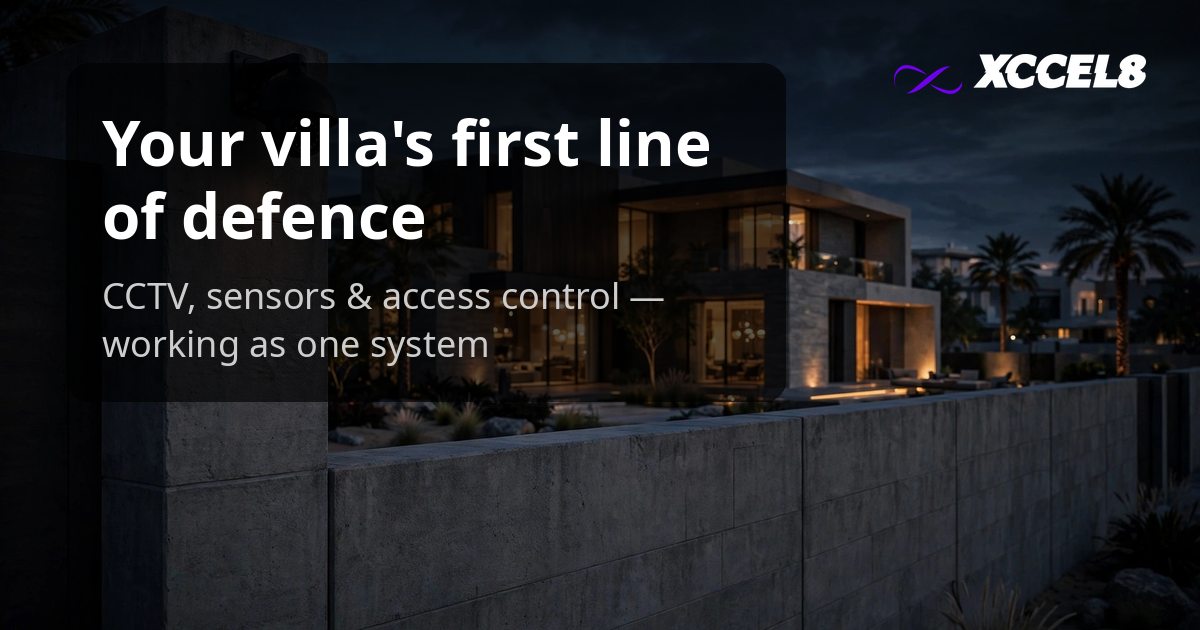
Securing a villa starts at the boundary wall, not at the front door. A proper villa perimeter security setup layers four things:
One camera by the door is not a security system; it is a recording of what already happened.
Most villa break-ins in residential communities follow the same pattern: the boundary is crossed quietly — over a side wall or through a service entrance — and the intruder reaches a door or window unchallenged. Each layer of your system exists to catch them at a different stage of that approach.
Key takeaways
The boundary wall is your first and most valuable line of defence, because it gives you the earliest warning. Cameras mounted to cover the boundary should watch more than the front of the house:
Wide-angle cameras miss faces at distance; a mix of overview cameras and tighter views at gates and entry points gives you both coverage and usable detail.
Where cameras alone fall short is after dark or when nobody is watching the feed. That is where perimeter detection earns its place: infrared beams or outdoor motion sensors along the wall trigger an alert the moment someone crosses, whether or not anyone is looking at a screen. In Dubai’s villa communities — from Arabian Ranches to JVC — boundary walls are typically low enough to climb, which makes this layer more important than many homeowners assume.
One practical note: CCTV installations in Dubai are regulated by SIRA, and compliant installations matter if footage ever needs to support a police report. Professional installers work with SIRA-certified partners to make sure camera placement, recording retention and system registration meet the requirements. A handyman with a ladder cannot give you that.
Cameras watch; sensors react. Glass-break sensors listen for the specific acoustic signature of shattering glass and cover the sliding doors and large windows that villas are full of — the exact entry points intruders prefer. Door and window contacts detect opening, and indoor motion sensors cover hallways and stairwells as a final tripwire.
These sensors connect to an alarm panel that does three things the moment one triggers:
The key design decision is zoning: the system should be able to arm the perimeter (doors, windows, glass) while you are home and moving around inside, and arm everything when the villa is empty. A system that forces you to choose between false alarms at midnight and no protection at all will end up switched off within a month.
The main gate is where most villa owners under-invest. A basic remote-controlled gate tells you nothing about who came and went. A video intercom at the gate — with the feed on your phone — means you can see and speak to a visitor from anywhere, open the gate remotely for a delivery, and keep a record of every entry.
For households with drivers, domestic staff, gardeners and pool maintenance crews coming and going, PIN codes or RFID tags per person beat a shared remote: you can give the gardener access on Tuesday mornings only, and revoke it instantly when the contract ends. Smart locks on the main door add the same control inside — temporary codes for guests, no more keys under the mat, and a log of every entry.
Biometric readers (fingerprint or face) at the main entrance are increasingly common in new Dubai villas, and they remove the weakest link entirely: the credential that can be copied, lost or shared.
Two things quietly kill villa security systems in the UAE. The first is power: a system that dies in a DEWA outage is a decoration. The alarm panel, NVR and key cameras should sit on a UPS that carries them through short outages, and the system should alert you — not just go dark — if mains power is lost for an extended period.
The second is fragmentation: cameras on one app, the alarm on another, the gate on a third remote. When an alarm triggers at 2am, you do not want to be switching between three apps to see what happened. A properly designed system brings cameras, intrusion sensors and access control into one interface, so a glass-break alert automatically pulls up the nearest camera feed. That integration is the difference between a collection of devices and an actual security system.
A security system is only as good as its last test. A quarterly walkthrough takes twenty minutes:
That walkthrough catches the small failures before they matter.
If your villa has more than a handful of cameras, a boundary wall worth protecting, or multiple people needing different levels of access, this stops being a DIY project. A proper site survey:
Start at the boundary, layer detection over observation, control who gets in, and tie it all into one system. That is what turns cameras and sensors into security.
What does villa perimeter security include?
Villa perimeter security layers four things: CCTV cameras watching the boundary and entry points, intrusion sensors on doors and glass, controlled access at the gate, and a single integrated system so an event on one layer triggers the right response on the others.
Do villa CCTV installations in Dubai need SIRA approval?
CCTV installations in Dubai are regulated by SIRA, and compliant installations matter if footage ever needs to support a police report. Professional installers work with SIRA-certified partners to make sure camera placement, recording retention and system registration meet the requirements.
How do glass-break sensors work?
Glass-break sensors listen for the specific acoustic signature of shattering glass. They cover the sliding doors and large windows that villas are full of — the exact entry points intruders prefer — and connect to an alarm panel that sounds the siren, alerts your phone and notifies your monitoring provider.
Can I keep the alarm on while my family is home?
Yes — this is what zoning is for. The system arms the perimeter (doors, windows, glass) while you are home and moving around inside, and arms everything when the villa is empty. Without zoning, the choice is false alarms at midnight or no protection at all.
What most often goes wrong with villa security systems?
Two things: power and fragmentation. A system that dies in a DEWA outage is a decoration, so the panel, recorder and key cameras need UPS backup and power-loss alerts. And cameras on one app, the alarm on another and the gate on a third remote means nobody can respond coherently at 2am — the layers must live in one interface.

Zoho Desk for UAE businesses: how a proper ticketing system replaces support-over-WhatsApp, with SLAs, knowledge bases and multi-channel inboxes explained plainly.

3CX phone systems for UAE offices: what a software-based PBX does, the features that matter day to day, and what switching from traditional phone lines involves.

AI consulting is on the rise in growing UAE companies: how AI-assisted workflows reduce the need for additional hiring, cut operating costs, and why professional consultation matters for implementation.
Tell us what your business needs — our engineers will cut through the jargon and recommend the right solution at the right price. No obligation.
Thanks — our team will contact you shortly.