Application·
Zoho Desk: bringing order to customer support in UAE businesses
Zoho Desk for UAE businesses: how a proper ticketing system replaces support-over-WhatsApp, with SLAs, knowledge bases and multi-channel inboxes explained plainly.

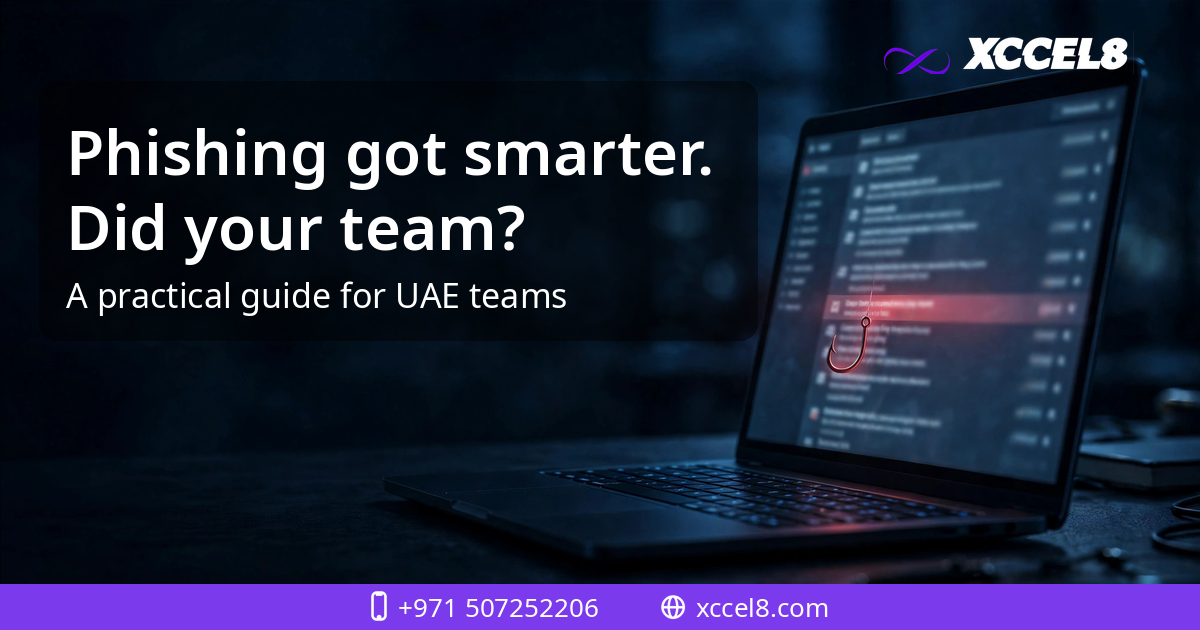
The phishing email of ten years ago was almost a caricature: broken English, a generic “Dear Customer”, a prince offering you money. Most office workers learned to spot those in seconds — and that training worked, for a while.
It does not work anymore. Today’s phishing messages are written in fluent, natural language, address you by name, reference your actual suppliers, and arrive at exactly the right moment. Generative AI has removed the two most reliable warning signs people were ever trained on — poor grammar and generic messaging — and the result is lures that are nearly indistinguishable from legitimate mail. This is why phishing remains one of the most common ways attackers get into businesses, year after year.
For UAE teams, where business moves fast across email, WhatsApp and SMS, the exposure is constant. Here is a practical look at how phishing works in 2026, why people fall for it, and what actually stops it.
The old tells are gone
Most security awareness training from the last decade taught staff to look for clumsy language and impersonal greetings. Attackers have adapted. AI-crafted phishing now reads perfectly, adopts the tone of the impersonated colleague or vendor, and personalises the message with details scraped from public sources. The “obvious fake” is increasingly the exception, not the rule — so a team trained only on the old signs is effectively unprotected against the new ones.
New lures: QR codes, voice calls and text messages
Phishing has also diversified beyond email. QR-code phishing — sometimes called “quishing” — accounts for roughly 12% of phishing incidents in some analyses: a code on a poster, in a PDF attachment, or even inside an otherwise innocent email sends the victim’s phone to a fake login page, neatly bypassing email scanners that never inspect the image. Voice phishing (“vishing”) uses AI-cloned voices to impersonate executives or IT support on a phone call, while SMS phishing (“smishing”) exploits the urgency people feel about a text. The 2026 Verizon Data Breach Investigations Report — which covered 31,000+ security incidents and 22,000+ confirmed breaches across 145 countries — found that multiple studies attribute over 36% of breaches to phishing as the initial access vector, and in some studies phishing is involved in around 90% of successful cyberattacks. The channel keeps changing; the tactic stays the same.
What actually gets people: urgency, authority, routine
Phishing works because it exploits how people behave at work, not because of technical trickery. Three patterns account for most successful lures:
It is worth remembering that phishing rarely acts alone. The 2026 DBIR found that exploitation of vulnerabilities has overtaken credential abuse for the first time as the leading initial access vector at 31% — but stolen credentials harvested through phishing remain a close and closely related second act. And the stakes are high: ransomware appeared in 48% of breaches in the 2026 report, with a median ransom paid of $139,875 — while 69% of victims refused to pay. Separately, third parties were involved in 48% of breaches, which is why a fake invoice from a “supplier” can be so damaging. For smaller businesses the exposure is real: 96% of ransomware victims, where organisation size was known, were SMBs.
The practical defence stack
No single tool stops phishing. What works is a layered stack, and none of these layers is expensive or exotic:
The first hour after someone clicks
Someone will click eventually. What happens in the next hour decides whether it is an anecdote or an incident:
Write this procedure down, keep it to one page, and make sure everyone knows where to find it. An untested plan is barely better than no plan.
Get a professional view of your exposure
Phishing defence is not a product you buy once; it is a combination of the right email security, enforced MFA, tested people and a rehearsed response plan. Most businesses we assess are weaker in one of these areas than they think — usually the training and the incident procedure.
If you want an honest picture of where your business stands, Xccel8’s cyber security services in Dubai start with a free cyber-security review: we check your email security posture, MFA coverage and staff awareness approach, and give you a clear, prioritised list of what to fix first. No jargon, no scare tactics — just the gaps and how to close them.
Too technical? We will simplify it. Book a free consultation and we will walk you through your current defences in plain language.
Zoho Desk for UAE businesses: how a proper ticketing system replaces support-over-WhatsApp, with SLAs, knowledge bases and multi-channel inboxes explained plainly.
3CX phone systems for UAE offices: what a software-based PBX does, the features that matter day to day, and what switching from traditional phone lines involves.
AI consulting is on the rise in growing UAE companies: how AI-assisted workflows reduce the need for additional hiring, cut operating costs, and why professional consultation matters for implementation.
Tell us what your business needs — our engineers will cut through the jargon and recommend the right solution at the right price. No obligation.
Thanks — our team will contact you shortly.